
Weekly Rewind: 3/6/26
Schumer, 13 Senate Dems Intro Bill to Break Up Meatpacker Monopoly

By Kainoa Lowman
Welcome back to the The Economic Populist’s Weekly Rewind. Every Friday, we’ll briefly recap the week’s biggest news, updates, and developments in the fight against corporate power.
Here’s what to know this week.
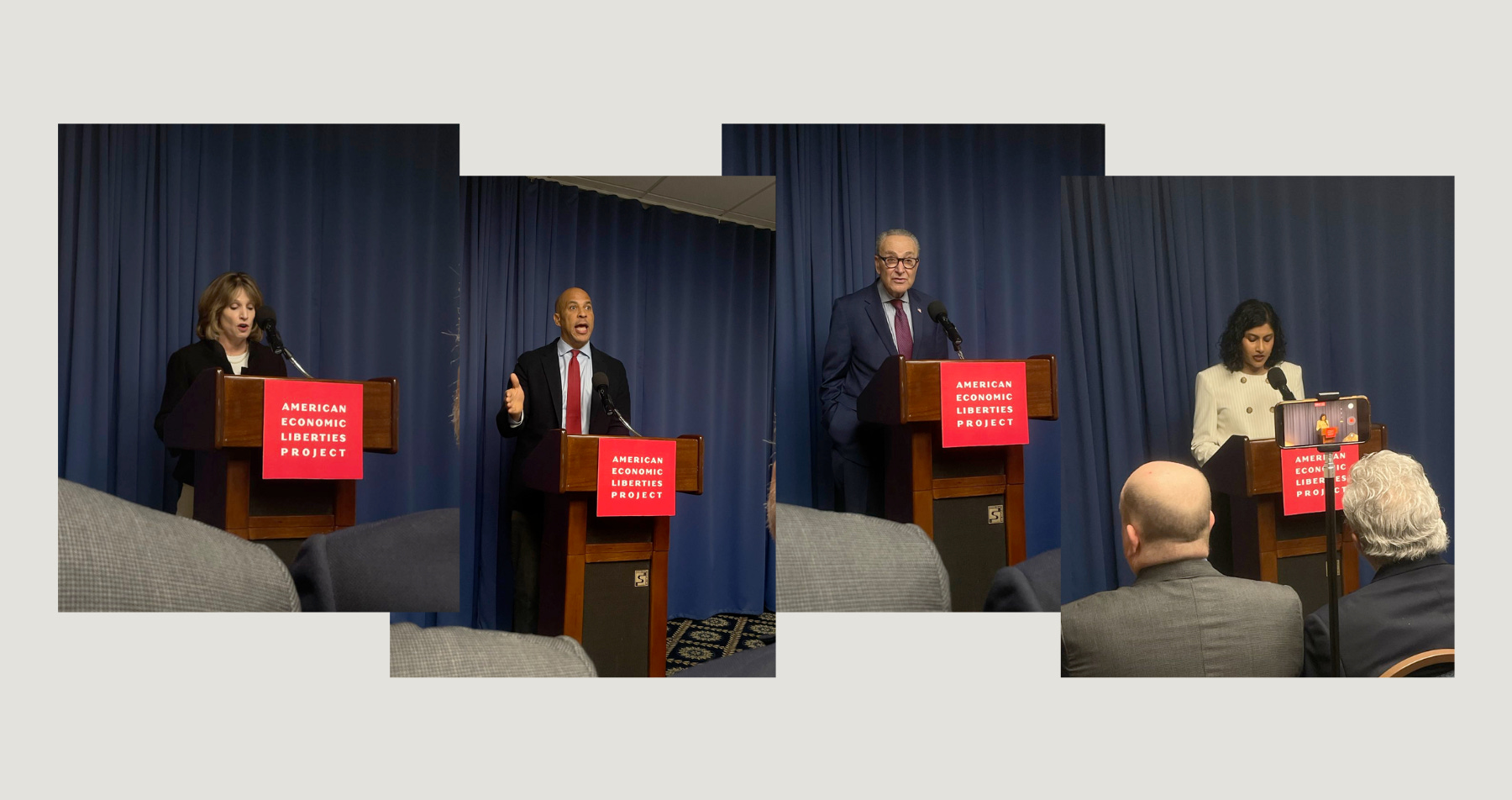
Schumer, 13 Senate Dems Intro Bill to Break Up Meatpacker Monopoly
On Thursday, Democratic Senate Leader Chuck Schumer introduced a bill, backed by twelve other Senate Democrats, to break up America’s largest meatpackers.
This is a big deal—and we’re not not just saying that because Sens. Schumer, Cory Booker, Ruben Gallego, and Peter Welch formally unveiled the bill at a news conference hosted by Economic Liberties. Or because the Senators backing the bill run the gamut of Democrats’ political spectrum and also include Bernie Sanders, Andy Kim, and Brian Schatz. Or because Economic Liberties has been active in making the case on the impact of consolidation across the economy on our nation’s ever-increasing cost of living.
It’s important because dominant meatpackers are a major and hidden culprit behind the grocery affordability crisis, and a life-threatening parasite on the ranchers and farmers that actually feed Americans, — Schumer is using his power to to lead the effort to bust them up.
Over the last few decades, weak antitrust enforcement allowed the so-called “Big Four” meatpackers—JBS, Tyson, Cargill, and National Beef—to gain control of 85% of beef processing in the US, as well as large shares of pork and poultry processing.
There is reason to believe this market power is further enhanced by price-fixing and collusion, which the Big Four have been regularly accused of for years, including by the Department of Justice Antitrust Division. Indeed, as Sen. Booker put it at the news conference, the Big Four treat multi-million dollar legal settlements as “just another cost of doing business.”
This market structure has been devastating for consumers and producers. Americans are paying record prices for beef, which is up 15% in the last year; chicken and pork prices have increased sharply over the last decade-plus. Yet at the same time, producers‘ earnings as a share of each dollar spent have cratered. For beef, that share has declined from 70 cents of each dollar in 1970 to an unsustainable 30-40 cents in recent years. According to the USDA, between 2002 and 2022, roughly 58,000 cattle feedlots (72% of the 2002 total) and 18,000 hog farms (23%) exited the market.
“It’s hollowing out our rural communities,” said Joe Maxwell, a longtime farmer and President of Farm Action Fund, one of several farmer, rancher, and independent restaurant associations that showed support at the news conference. “All while a handful of corporations make excessive profit.”
The Family Grocery and Farmer Relief Act would address this crisis by requiring the dominant meatpackers to divest plants in cattle and beef markets where they hold excessive market share, and divest their assets in chicken and pork lines of business entirely. It would also provide financial support for small and midsize processors, as well as farmers’ and workers’ cooperatives, to purchase divested plants from the dominant incumbents. Finally, it would take decisive steps to free the meat and poultry supply chains of exclusionary dealing (where incumbents explicitly or implicitly forbid producers from selling to competitors), assuring those new, independent processors that they will have a fair opportunity to compete.
This bill hits all the right notes. As Economic Liberties Executive Director Nidhi Hegde put it in her introduction of Sen. Schumer: “At Economic Liberties we know you cannot address a problem rooted in corporate power by tinkering around the edges. You have to be willing to attack it structurally. You have to be willing to take on the biggest names in the industry … Senate Democrats have introduced a bill that does just that.”
So, what are the bill’s prospects in Congress? The fact that it has been introduced by the highest levels of Democratic leadership—and has the backing of a large share of the caucus right out of the gate—is a victory in and of itself. It’s the latest proof that antimonopoly politics has firmly entered the mainstream. And it could have bipartisan potential, given farmers’ leanings as a political constituency and the mounting pressure on President Trump to convince voters that he is acting to lower costs. Reminder: In November, President Trump directed the Department of Justice to investigate collusion and price fixing among dominant meatpackers. Nonetheless, Trump has a long record of broken affordability promises, and the real fight over this bill likely lies ahead, when it comes time to ensure the bill’s backers follow through on pushing it if and when they regain majorities in Congress.
At the news conference, Schumer vowed to do just that.
“It is time for Congress to do what progressives of years past did so well: take action to break monopoly power,” he said. “My bill will do exactly that. It’s part of our Democratic agenda. We get the majority, we’re gonna get this done.”
Quick Hits
The private credit market continues to emit distress signals. On Friday,BlackRock announced it will restrict investor withdrawals from a flagship credit fund, becoming the latest in a string of major firms to make such announcements. A day earlier, Bloomberg reported that the company had slashed the value of a $25 million loan to an e-commerce company to zero, just three months after assessing it at 100 cents on the dollar, in just the latest evidence that private lenders are facing big losses.
A judge has ordered the Trump administration to begin refunding $130 billion-plus in tariff revenue, following February’s Supreme Court ruling against its tariff authority. Meanwhile, Treasury Secretary Scott Bessent announced on Wednesday that the administration plans to hike the new global tariff rates it has imposed under a different law from 10% to 15%.
Economic populist James Talarico won the Texas Democratic Senate primary.
Sens. Elizabeth Warren and Tim Scott unveiled the latest version of their bipartisan ROAD to Housing Act, which incorporates language passed by the House and has the President’s support. Among other measures, the bill would streamline the permitting process, encourage manufactured housing, and ban large institutional investors from owning more than 350 single-family homes.
The Trump administration officially blacklisted Anthropic for refusing to agree to the military’s proposed terms for use of its Claude AI model in a major — and quite possibly illegal — use of executive power.
Keep up the good work. There may be hope for the USA yet.