
Weekly Rewind: 2/6/26
How Big Tech Killed the Washington Post, and more.


By Kainoa Lowman and Katie Hettinga
Welcome back to the The Economic Populist’s Weekly Rewind. Every Friday, we’ll briefly recap the week’s biggest news, updates, and developments in the fight against corporate power.
Here’s what to know this week.
How Big Tech Killed the Washington Post
On Wednesday, the Jeff Bezos-owned Washington Post laid off an estimated 30 percent of its staff, including over 300 journalists. The brutal cuts represent the end of one of America’s most iconic newspapers as we know it. While the entire newsroom was impacted, the international and metro sections were decimated, and the sports section is closing altogether. A fired Ukraine correspondent was seemingly left stranded in a war zone. Perhaps most tellingly, the San Francisco bureau was brutally cut back, with the staffer responsible for covering Amazon among those fired.
The Post’s top management portrayed the cuts as a necessary response to shifting technology and news consumption habits, and said they want to refocus the paper on national, political, and business news — though no one offered an explanation for how defenestrating the San Francisco bureau and axing the Amazon reporter will help achieve that latter goal.
The real cause of the paper’s financial struggles is far darker.
The Post’s waning business is not an inevitable consequence of technological change. The paper thrived during Trump’s first term, adopting the “Democracy Dies in Darkness, ” capitalizing on the huge demand for scrutiny of the administration. The Post achieved profitability in 2017 and 2018. By some measures, its influence was greater than that of the New York Times.
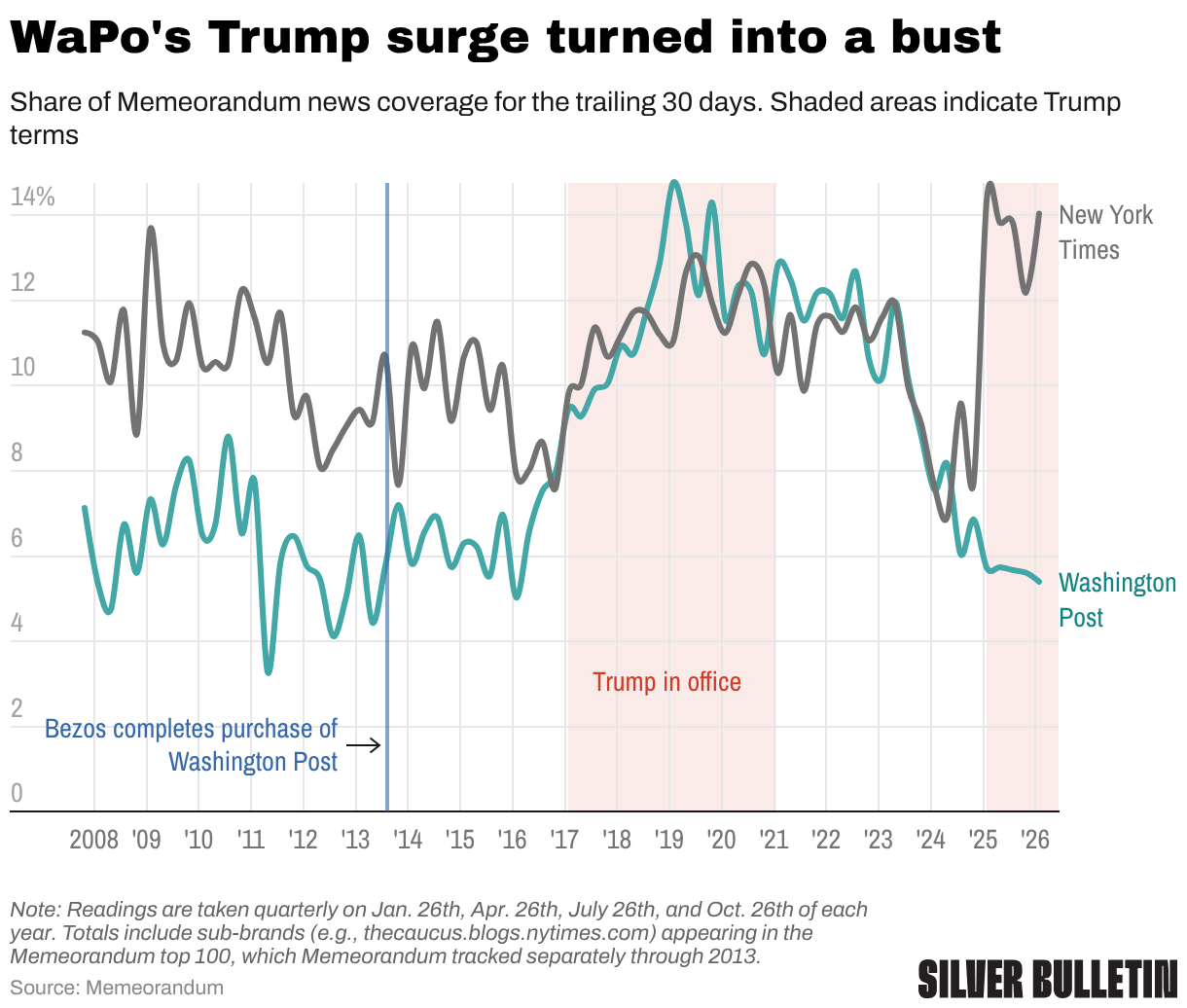
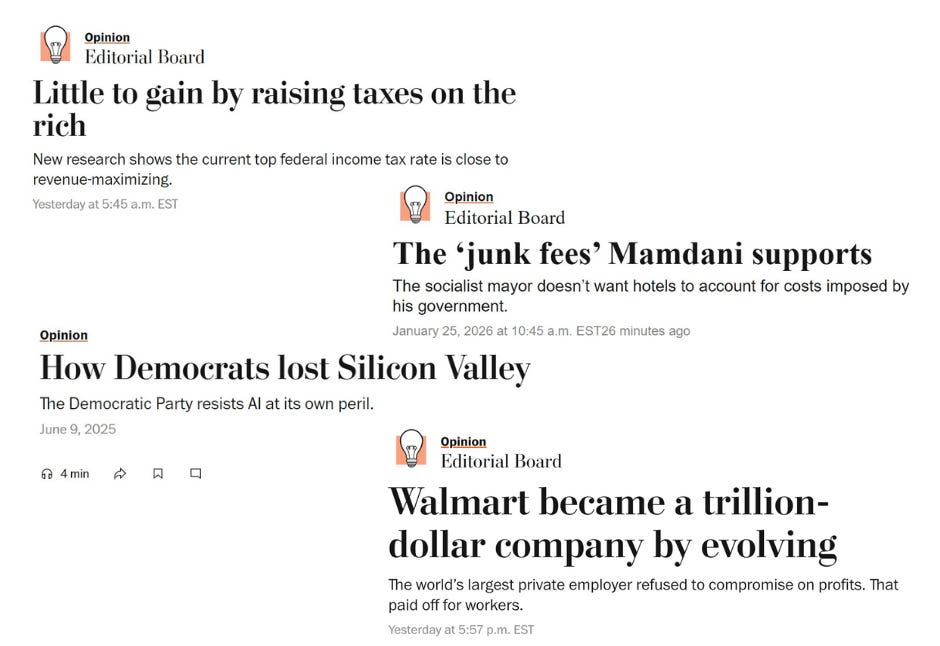
The true threat to the Post turned out to be Bezos himself. Senator Bernie Sanders perceived this back in 2019, and was labeled a conspiracy theorist for it. But five years later, Sanders would be proven right. About a week before the 2024 election, Bezos intervened to squash the Post’s planned endorsement of Kamala Harris, seemingly to curry favor with a potential President Trump. The action outraged Post readers, and the paper hemorrhaged over 250,000 subscribers in a matter of days. Shortly after Trump took office, Bezos stepped in again, with a publicly-broadcast mandate to refocus the Post’s opinion section on defending “personal liberties and free markets.” In practice, this has meant defending powerful corporations and the oligarch class while attacking attempts at populist governance—a cheap knockoff of the Wall Street Journal’s opinion pages. Many talented reporters and columnists either voluntarily left or were forced out. The financial losses piled up.
Yet the technological headwinds Post management cited in making this week’s cuts are very real—and they’re being driven by the industry the Post no longer intends to hold accountable. Google’s monopoly on “adtech” services allows it to extract an outsized share of online advertising revenues: by some estimates, at least 35 cents of each dollar spent by advertisers. Now, uncompensated scraping of news content by AI companies poses an even greater threat. This includes Google’s new “AI Overviews” feature, which regurgitate news content without driving monetizable traffic to publisher websites.
It must be emphasized that these challenges have to do with market structure, not technology per se. The question of whether AI companies must compensate news publishers for using their content is winding its way through the courts. Legislation allowing publishers to collectively bargain against Google would help news outlets claim their fair share of online advertising revenue, and resist extractive features like AI Overviews. Antitrust decisions to break up Google would also reduce the platform’s ability to squeeze publishers. Earlier this week, the Department of Justice announced it will appeal a judge’s decision not to pursue a breakup after ruling that the company had illegally monopolized the search market. In a separate case, a judge ruled Google illegally monopolized the adtech market, and is expected to issue a decision early this year on whether a breakup is warranted.
These challenges facing the journalism industry are not without solutions. But you’re unlikely to hear much about them in the new Washington Post. In a sick ironic twist, Bezos is now using the dire conditions partially created by his transformation of the Post into a mouthpiece of oligarchy as cover to advance that project.
White House Messaging Doesn’t Match Reality
The Wall Street Journal recently published an op-ed by President Trump in which he claims that his tariffs “have brought America back.” A smaller trade deficit, greater manufacturing employment, trillions in new investment, and low inflation are among the imagined record of wins delivered by his tariff policy.
In reality, the number of U.S. manufacturing jobs dropped by 68,000 employees from December 2024 to December 2025. The trade deficit in the first 11 months of 2025 was billions of dollars larger than the same period in 2024. Inflation remains higher than the Fed’s target. And the investment figures Trump claims are questionable, given he claims pledges for $20 trillion in new foreign investment in the United States. That would be one-fifth of the entire world’s global economic activity.
Beyond the gap between claims and known results is a worrying trend of missing data. Several 2025 government data releases regarding trade balances and jobs are still delayed despite the fall shutdown ending months ago. The Consumer Price Index was not published at all for October 2025 and the administration has said it never will be released.
Gaps between claims and policy reveal a similar pattern. Trump said he is committed to rebuilding the U.S. shipbuilding industry, then during a meeting with Chinese President Xi, he agreed to suspend fees on Chinese ships entering U.S, ports and other penalties imposed after an investigation into the Chinese government’s mass subsidies and trade abuses in the shipbuilding sector. He promised tariffs on vital industries to rebuild domestic production — even bragging recently that his 25% tariffs would bring back the U.S. auto industry. But Trump cut auto tariffs on most of the main importing countries including Japan, Korea, and Germany. The administration claims it has new trade agreements with dozens of countries despite there being no agreement text made public for most claimed deals.
Clearly, the U.S. trade and manufacturing policy of the past three decades has been a painful failure. But false claims about the success of the Trump’s erratic, bombastic, corrupt and self-defeating trade policies are not the way to fix it. Honest descriptions of policies and accurate data measuring outcomes are the only path to the dramatically new approach we need.
Quick Hits
Economic Liberties released a new whitepaper breaking down how private jet travel causes congestion in US airports, and offering policy recommendations to make air travel more equitable.
Trump Administration launched TrumpRx.com, which aims to aggregate direct-to-consumer demand for branded drugs in order to provide discounts. STAT news has a good breakdown of the fundamental shortcoming of the initiative, which does appear to offer some genuine benefits, such as cheaper access to IVF but, ulimately, “is designed for cash-paying, uninsured patients rather than the roughly 85% of Americans with prescription drug insurance coverage.”
The Federal Trade Commission settled a Lina Khan-era lawsuit against Cigna-owned pharmacy benefit manager Express Scripts for inflating insulin prices. The settlement is a mixed bag—Economic Liberties broke it down here.
Rep. Alexandria Ocasio-Cortez called out how excessive utility rates of return are driving up energy prices, referencing an idea popularized by Economic Liberties Senior Fellow Mark Ellis.
Rep. Maggie Goodlander is pushing back against an egregious 43.4% Eversource utility rate hike that will impact New Hampshire residents—more on this next week.
Former DOJ Antitrust chief Jonathan Kanter joined Rep. Pramila Jayapal for a town hall discussion on how consolidation is driving up grocery prices.
Senior Fellow for Airlines and Travel Bill McGee joined the Capitol Forum’s podcast to discuss AI pricing in airline ticketing.
The California Law Revision Commission voted unanimously to support reform of the state’s illegal monopolization law, following advocacy from Economic Liberties and a broad coalition of labor and business partners.
ICYMI: Policy Analyst Ashley Nowicki wrote about how the data center build out is shaking up key midterms races for The Economic Populist.